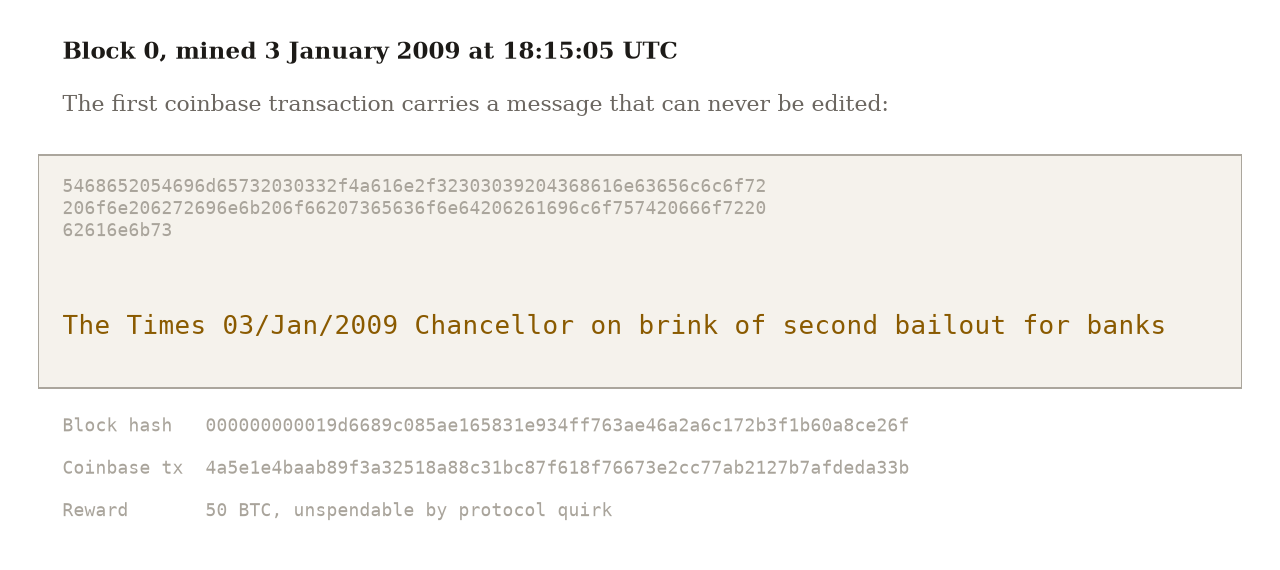
On the morning of January 3, 2009, the front page of The Times of London carried a headline that read like a status report from a failing machine: “Chancellor on brink of second bailout for banks.”
Britain had already rescued its banks once, three months earlier. It hadn’t held. The crisis was ten weeks from Bernanke’s 60 Minutes interview; the emergency era this book has spent five chapters tracing was being born in real time, on front pages exactly like that one.
Somewhere in the world that day — nobody knows where — a programmer working under the name Satoshi Nakamoto started a piece of software and created the first entry in a new ledger. Into that first block, permanently, the programmer typed one line of text: the date and headline of that morning’s Times.
Read it as it was intended, because it does two jobs at once. It’s a timestamp — proof the block wasn’t created earlier than that newspaper. And it’s an epitaph, chiseled into the foundation stone of the alternative. Here is the moment of your system’s failure, recorded inside the first block of its replacement. The message has now sat there, unaltered and unalterable, through every crisis since. It cannot be edited, because the system it launched was designed — before anything else — so that no one would ever be in a position to edit it.
Part I of this book was history; you could check every claim against a newspaper. Part II is a case, and you should hold it to a different standard — keep your skepticism within reach at all times. This chapter’s only job is to convince you of one narrow thing: that an asset which cannot be debased now exists, that this had never been true of anything before 2009, and that its existence matters enormously to anyone who followed the arithmetic of the last five chapters. What to do about it — how much, how, whether at all — waits until Part III, after the bear case has had its full say.
Strip away seventeen years of noise — the memes, the manias, the men on the internet — and Bitcoin is one thing: a ledger. A list of who owns what, like the one your bank keeps, with two differences that change everything.
First, no one keeps it — everyone does. The full ledger is copied onto tens of thousands of computers around the world, each independently checking every entry against the rules. Your bank’s ledger is a private book you’re not allowed to see; this one is a public book no one is allowed to alter. The balance of every account, back to that January morning in 2009, is auditable by anyone with a laptop. Seventeen years of trillion-dollar incentive to cook these books, and no one ever has — not because people are honest, but because the design makes the cooking harder than the earning.
Second — and this is the property this book has been walking toward since page one — the ledger’s money supply is fixed by rule. New bitcoin enters circulation on a schedule written in 2008 and executed, block by block, ever since: an issuance that cuts in half every four years, tapering toward a hard ceiling of twenty-one million coins, of which more than twenty million already exist. No committee can adjust the schedule. No emergency can accelerate it. There is no chairman, which means there is no chairman to fold.
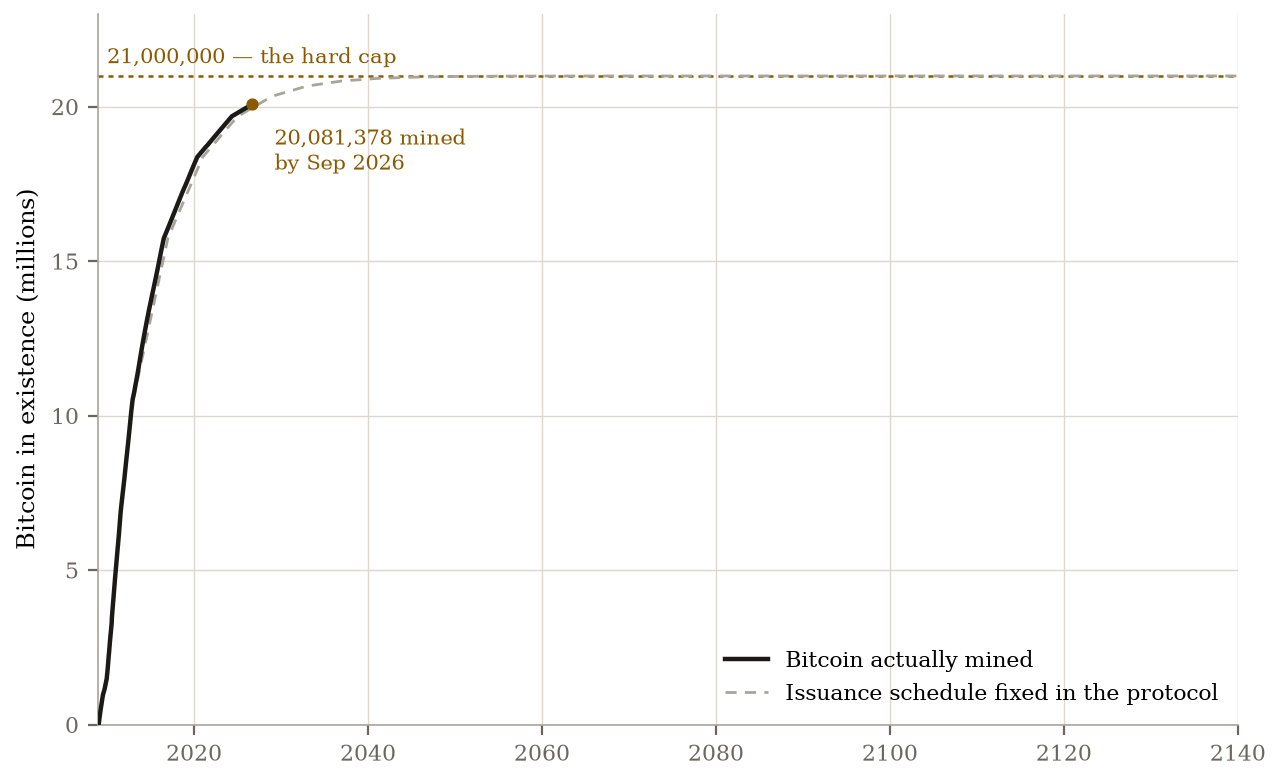
The skeptic’s first good question arrives right here: rules are just software, and software can be changed — who’s to say the cap holds? The answer is the most elegant part of the design. Changing Bitcoin’s rules requires convincing the people who hold and run the network to adopt the change — and the twenty-one-million cap is the reason most of them are there at all. A version of Bitcoin with a higher cap isn’t an upgraded Bitcoin; it’s a new asset that the existing holders, by definition, don’t want. The rule protects itself: everyone with the power to break the promise is someone whose wealth depends on the promise being kept. Contrast that with the dollar, where the power to debase belongs to exactly the people whose careers depend on using it. Incentives, not code, are the vault.
One more piece of the machine deserves thirty seconds, because it answers the objection most people never think to raise. In every other asset humans have ever used as money, demand summons supply. Gold triples in price and mining companies tear open new continents; the money supply itself, as Part I established at length, expands to meet every emergency. Bitcoin severs that link with a mechanism called the difficulty adjustment: every two weeks or so, the network measures how much computing power is trying to produce new blocks and re-tunes the puzzle so that blocks — and the new coins in them — keep arriving on schedule, no faster. Double the miners, and you don’t get double the bitcoin; you get the same bitcoin, harder won. Price can rise a hundredfold and the supply schedule will not add a single coin.
Pause on what that means. Land was the old benchmark of scarcity, and even land responds to demand — the Dutch built more Netherlands. Bitcoin is the first asset in human history whose supply is perfectly indifferent to how much anyone wants it. That is not an incremental improvement on gold. It is a new category: absolute scarcity, invented once, in 2009, as a direct answer to the machine described in Part I.
A claim that large deserves its cross-examination now, not in a footnote.
“It’s backed by nothing.” Correct — and look at who’s talking. Since the night in 1971 when this book began, the dollar has been backed by nothing but the discretion of the very committees Part I just spent five chapters watching fold under pressure. That’s the honest comparison: not Bitcoin versus some gold-backed dollar that no longer exists, but one unbacked money versus another. The dollar is unbacked with an unlimited-issue clause and a fifty-year record of using it. Bitcoin is unbacked without one. “Backed by nothing” isn’t an objection this book needs to dodge — it’s the entire subject of the book. Nothing scarce is backed by anything except the impossibility of making more of it. Ask gold.
“It’s absurdly volatile.” Also correct, and the number is worse than the skeptics usually cite: Bitcoin has lost roughly eighty percent of its value four separate times in its history, and the year this book was written has been ugly for the thesis — Chapter 11 opens there, on purpose. Anyone who tells you Bitcoin is a stable store of value today is selling something. The honest framing is different: Bitcoin is a candidate store of value, still being priced, and an asset traveling from zero toward whatever it turns out to be worth does not get to make that trip smoothly. Volatility is what monetization feels like from the inside — the price of admission for showing up before the question is settled. Whether that price is worth paying is a sizing problem, and sizing is Chapter 12’s job. What volatility does not do is touch the property this chapter is about. The price swings violently; the supply schedule has never moved by one coin.
“It wastes a country’s worth of electricity.” Bitcoin mining consumes real energy — on the scale of a mid-sized nation’s electric grid. The mistake is calling that waste, as if it purchased nothing. It purchases the thing this whole chapter is about: the cost of rewriting the ledger. Every entry in Bitcoin’s history is buried under an accumulating wall of expended energy, which is precisely why seventeen years of attackers have found it cheaper to obey the rules than to break them. Security that costs nothing is worth what it costs — 2008 was a tour of ledgers that were cheap to alter. You can argue the protection isn’t worth a nation’s power bill; that’s a real debate, and reasonable people are on both sides of it. But have the real debate: not “why does it cost so much,” rather “is an unforgeable ledger worth what it costs to forge.”
“It gets hacked constantly.” Read those headlines again, carefully, because they are the best-disguised argument for the design. Mt. Gox, FTX, the parade of failed exchanges — every one was a company, a middleman holding customers’ coins, failing the way middlemen have always failed: opaque books, borrowed customer funds, trust betrayed. Lehman, re-run with worse actors. The ledger itself has never been successfully rewritten — not once, through all of it. The 2008 lesson and the Mt. Gox lesson are the same lesson: the danger was never the asset; it was the intermediary you couldn’t audit. Bitcoin is the first asset where opting out of the intermediary is possible — you can hold it yourself, beyond any custodian’s balance sheet — and where the intermediaries that remain, the regulated funds and custodians of the ETF era, sit on top of a ledger anyone can check. The choice is the point.
So what is this thing for, in the portfolio of someone who has read Part I?
Start with what it is not for. Bitcoin is not a bet that America fails — the United States government itself now holds a strategic reserve of it, a development so strange it gets its own treatment in Chapter 10. It is not a bet that the dollar dies; Chapter 8 will argue the dollar’s dominance is, if anything, being extended by crypto. And it is not a lottery ticket, whatever its loudest fans promise.
It is insurance — against a specific, well-documented peril. Part I established that peril beyond reasonable doubt: every incentive, every actor, every precedent in the American monetary system points toward more issuance, and the compounding interest bill has quietly removed the reverse gear. You don’t buy fire insurance because you’re certain the house will burn. You buy it because you’ve read the wiring report. Part I was the wiring report. Bitcoin is the first policy anyone has ever been able to buy against that particular fire — an asset sitting entirely outside the system doing the issuing, whose supply cannot be voted, printed, eased, or emergency-measured into growing, held in a ledger no chairman can mark up on a Sunday night.
For fifty years, the melting this book describes had no clean other side. You could buy gold — and Chapter 1 showed how well that worked, but gold is heavy, hard to verify, hard to move, and its supply still leans into demand. You could buy stocks or houses — claims on productive assets, but claims wrapped in the very system doing the melting, as 2008 demonstrated. What never existed was the pure position: the asset that simply is not playing. Since January 3, 2009, it exists. That is the narrow, enormous claim of this chapter.
Bitcoin does exactly one thing: it takes the printer out of money. It refuses to do anything else — it doesn’t lend, doesn’t pay interest, doesn’t host applications; maximal security through minimal surface. Which raises the obvious next question. Money is only the first thing finance does. The lending, the trading, the settling, the escrow — the entire trust-selling apparatus that failed in 2008 — all of that still runs on ledgers you have to take someone’s word for. Someone rebuilt that, too. That’s the next chapter.
Bitcoin isn’t a bet against America. It’s insurance against arithmetic.
[Charts for this chapter: (1) Bitcoin issuance schedule 2009–2140 — the supply curve flattening into the 21M ceiling, halvings marked; (2) “demand cannot summon supply” — gold production response to price vs. Bitcoin’s, indexed; (3) the genesis block — rendered as an exhibit, headline text highlighted. Endnotes: Nakamoto white paper (Oct 31, 2008 — six weeks after Lehman); genesis block raw data; The Times front page Jan 3, 2009; Fidelity “Bitcoin First Revisited” and BlackRock “A Unique Diversifier” (SOURCES.md #6–7) for the institutional framing; Cambridge CBECI for energy; drawdown series per Ch. 11’s data. Note: Satoshi’s ~1M untouched coins deliberately NOT used here — candidate beat for Ch. 10 or 11 if wanted. All inline [VERIFY] tags resolved at fact-check pass 2026-07-26 — see VERIFICATION-partII.md; supply figure updated to “more than twenty million” (20.06M as of July 2026, 20-millionth coin mined March 2026).]