On a Sunday evening in August 1971, thirty million Americans sat down to watch Bonanza and got the President of the United States instead.
Richard Nixon had flown back from Camp David that afternoon after a secret weekend with his economic team — sixteen men, no note-takers, phones cut off from the outside world. What they had decided in those two days was so sensitive that the President went on television before the markets could open in Tokyo. He announced wage and price controls. He announced a tax on imports. And then, almost in passing, he announced the thing the weekend had actually been about:
The United States would “temporarily” suspend the convertibility of the dollar into gold.
He assured the country this was a technical measure, aimed at international speculators. And he closed with a sentence that deserves to be carved above the door of every bank in America: “Your dollar will be worth just as much tomorrow as it is today.”
Most people shrugged and waited for their show to come back on. It sounded complicated. It sounded temporary. It was neither. That broadcast is the single most important financial event of the last hundred years, and almost nobody alive can tell you the date it happened.
To understand what was broken that night, you have to understand what had been promised.
In July 1944, while the Second World War was still burning, delegates from forty-four nations gathered at a resort hotel in Bretton Woods, New Hampshire, to design the money of the postwar world. The system they built was a pyramid with something solid at the bottom. Every major currency was pegged to the U.S. dollar. And the dollar, alone among them, was pegged to gold: thirty-five dollars an ounce, redeemable on demand by any foreign government, guaranteed by the United States of America.
That guarantee did something subtle and enormous: it disciplined the printing press. America could issue dollars, but every dollar was a claim check on the gold in its vaults. Print too many claims, and sooner or later someone shows up at the window to collect. For a quarter century, that window kept the world’s money honest — and the quarter century it kept was not a bad one: the strongest run of broad, shared prosperity in American history, an era when a single factory wage bought a house, a car, and a future.
Then America started writing more claim checks than it had gold.
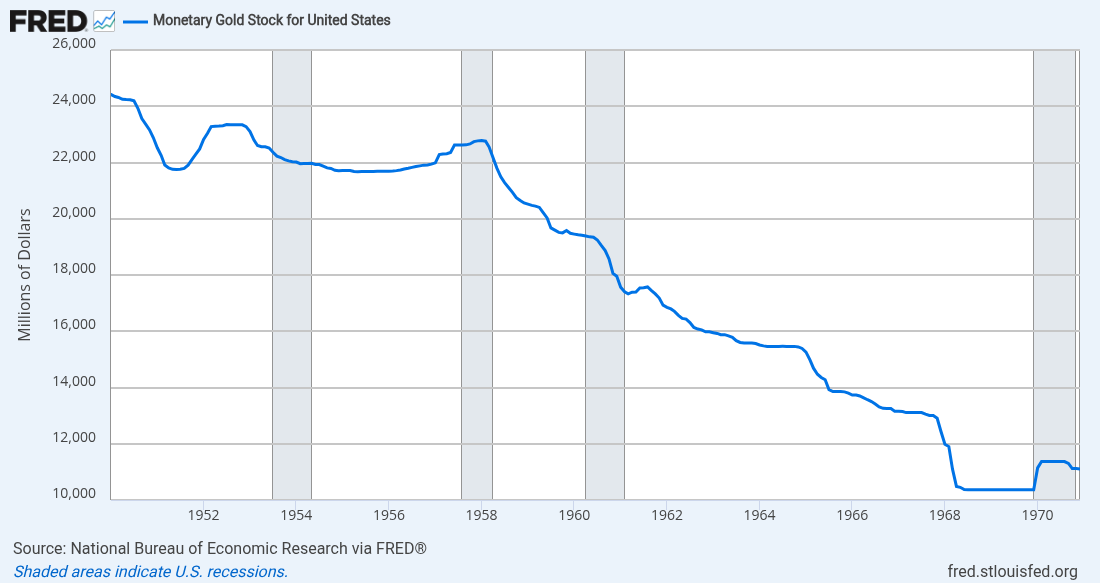
It wasn’t one decision; it never is. It was a war in Vietnam and a Great Society at home, both paid for the polite way — not with taxes, which voters feel, but with borrowing and issuance, which they don’t. Through the 1960s, dollars piled up in foreign vaults while the gold in American ones did not. By the end of the decade, foreign governments held several times more dollars than the United States had gold to redeem them with. The claim checks had quietly become musical chairs.
The French, being French, did the math first and said it out loud. President Charles de Gaulle’s government began redeeming its dollars — sending ships and aircraft, quite literally, to exchange paper for bullion and carry it home. Others followed more discreetly. In the second week of August 1971, Britain asked about protection for three billion dollars more. The run on the last gold window on Earth had begun, and every man at Camp David that weekend knew it.
So they didn’t defend the promise. They ended it.
One of the sixteen men in the room, incidentally — the one who drafted much of the plan, a six-foot-seven economist from the Treasury who privately believed the whole exercise would end in inflation — will get his own chapter shortly. Remember that he was there at the beginning. It matters.
The suspension announced that Sunday night has now lasted more than half a century.
No Congress voted to end the gold standard. No amendment was passed, no referendum held. One speech, on a weekend, and the money in every wallet on Earth changed from a claim on something into a claim on nothing. Economists gave the new arrangement a polite Latin name — fiat, “let it be done” — and the world simply adjusted, the way people adjust to anything that happens slowly enough.
From that night forward, a dollar was worth a dollar because the government said so, and for no other reason. Which meant that, for the first time in American history, there was no window anyone could show up to, no vault that had to balance, no physical limit of any kind on how many dollars could exist.
Every guardrail that follows in this book — every bailout, every trillion, every acronym from QE to whatever comes next — walks through the door that opened on August 15, 1971. Not because the men who opened it were villains. They were, by most accounts, serious people solving that weekend’s emergency. That’s the uncomfortable lesson of Part I, and it’s worth stating plainly the first time:
Nobody votes for debasement. They vote for rescues. Debasement is just the bill.
So how did the promise perform? Nixon said your dollar would be worth just as much tomorrow. We’ve now had roughly twenty thousand tomorrows. Let’s check.
The median new American house cost about $25,000 in 1971. Today it costs around $410,000. The average new car: $3,700 then, about $50,000 now. A year at a typical public university, a hospital birth, a ticket to the movies — pick any receipt from 1971 and the multiple lands in the same brutal range. Measured by official inflation, the dollar has lost roughly 87 percent of its purchasing power since that broadcast. A dollar tucked into a mattress that August night buys about thirteen cents’ worth of 1971 America.
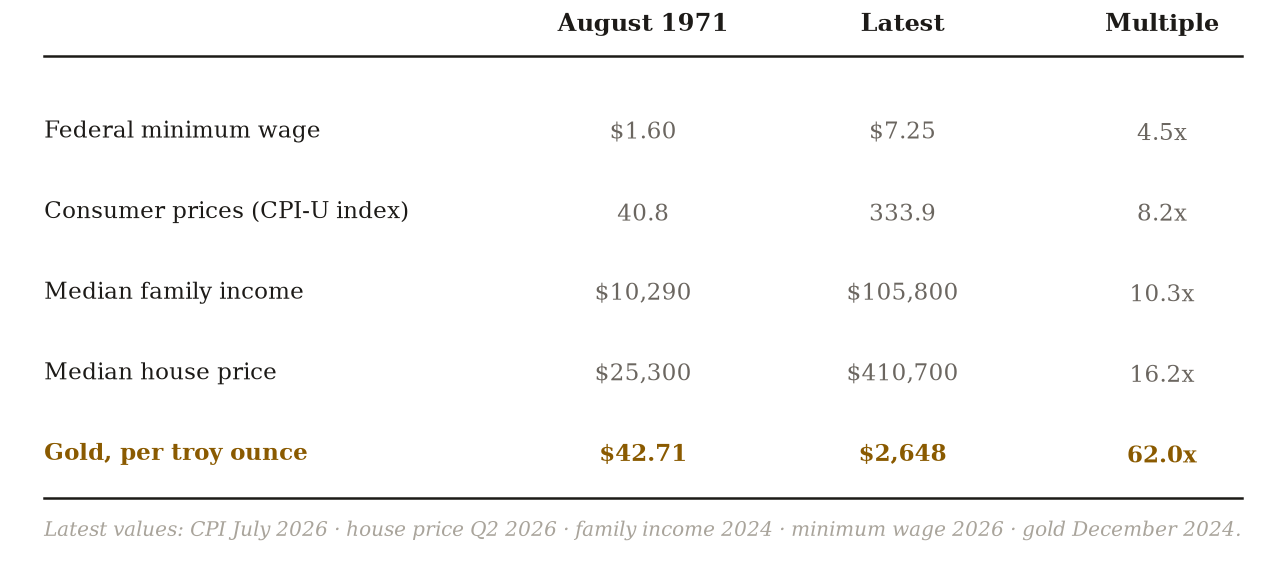
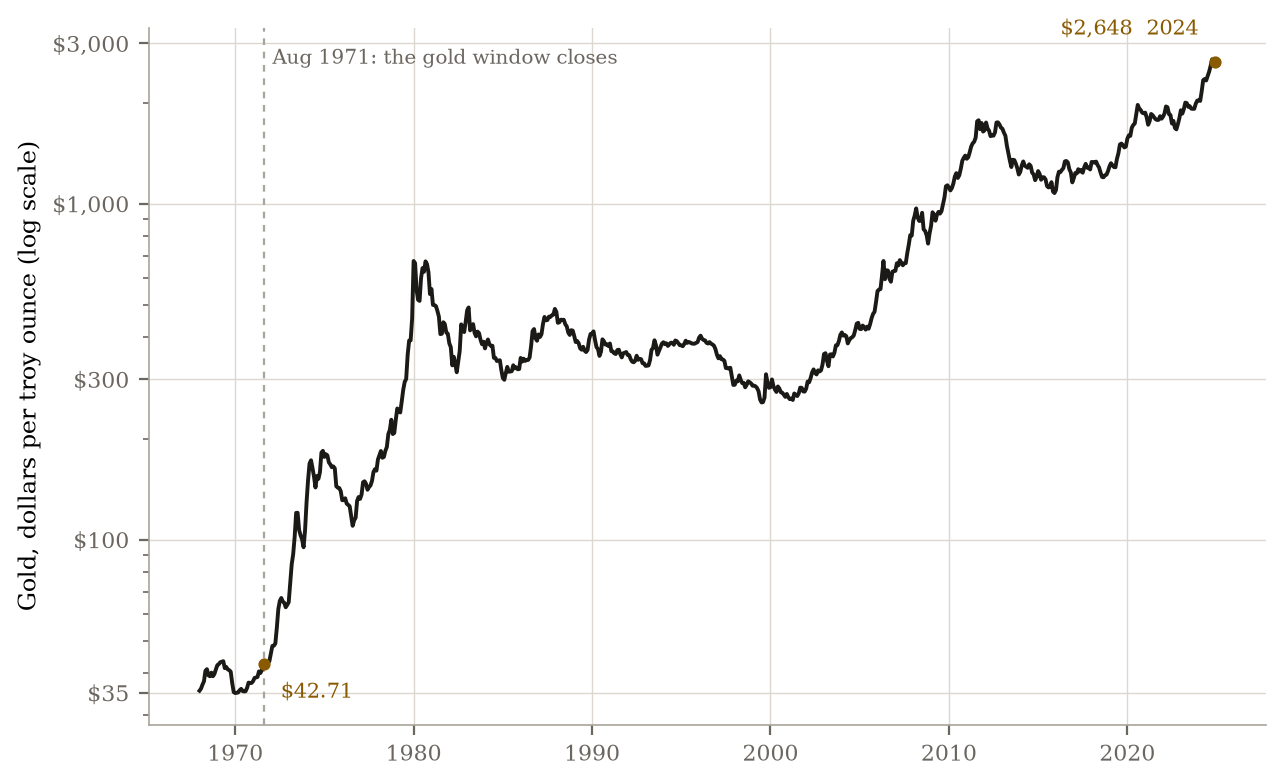
And the gold Nixon unpegged at thirty-five dollars an ounce? It trades today north of four thousand.
Sit with that last one, because people wave it away too quickly. Gold didn’t get better. It didn’t invent anything, acquire anyone, or report earnings. It is the same inert, useless, beautiful metal it has been for five thousand years. Its price didn’t rise a hundredfold because gold changed.
It rose because the thing measuring it shrank.
That is the single mental flip this entire book asks of you, so I’ll say it as plainly as I can: when everything gets more expensive across half a century — houses, cars, stocks, gold, tuition, insurance — the simplest explanation is not that everything is rising. It’s that the ruler is shrinking. Once you see prices that way, you can never quite unsee it. The stock market’s endless climb, the “unaffordable” housing your kids face, the way every generation needs a higher salary to live a smaller life — a great deal of it is one phenomenon wearing different costumes: the slow-motion repricing of everything, in units that melt.
A few months after the broadcast, Nixon’s Treasury Secretary — John Connally, a Texan with a gift for saying the quiet part — faced a room of European finance ministers furious about what the float was doing to their economies. His answer became famous:
“The dollar is our currency, but it’s your problem.”
He meant it as a boast to foreigners. Half a century later, it reads as a warning to anyone, anywhere, who stores the work of their life in dollars. It’s our currency. It’s your problem. It has been since the night they interrupted Bonanza.
There was, however, one moment — one — when America looked at the melting and decided to stop it at any cost. What it took to do it then, and why it can never be done again, is the next chapter, and it’s the hinge on which everything else in this book turns.
Since 1971, saving dollars has been a decision to get poorer slowly.
[Charts for this chapter: (1) purchasing power of $1, 1971–2026; (2) gold price 1971–2026, log scale; (3) US gold reserves vs. foreign dollar claims, 1950–1971. Endnotes: Nixon speech transcript; Camp David accounts (Volcker, “Changing Fortunes”); median home/car prices — Census/BLS; CPI calculator; Connally quote sourcing; [UNVERIFIED — no audience figure found: Nixon Foundation, Nixon Library, Federal Reserve History, and contemporaneous accounts of the Aug. 15, 1971 address say only that “millions of Americans” were watching; no Nielsen or other numeric estimate for the broadcast audience was located].]